
Gran Sasso d'Italia
The highest massif in the mainland Apennines and the southernmost glacial body in Europe.
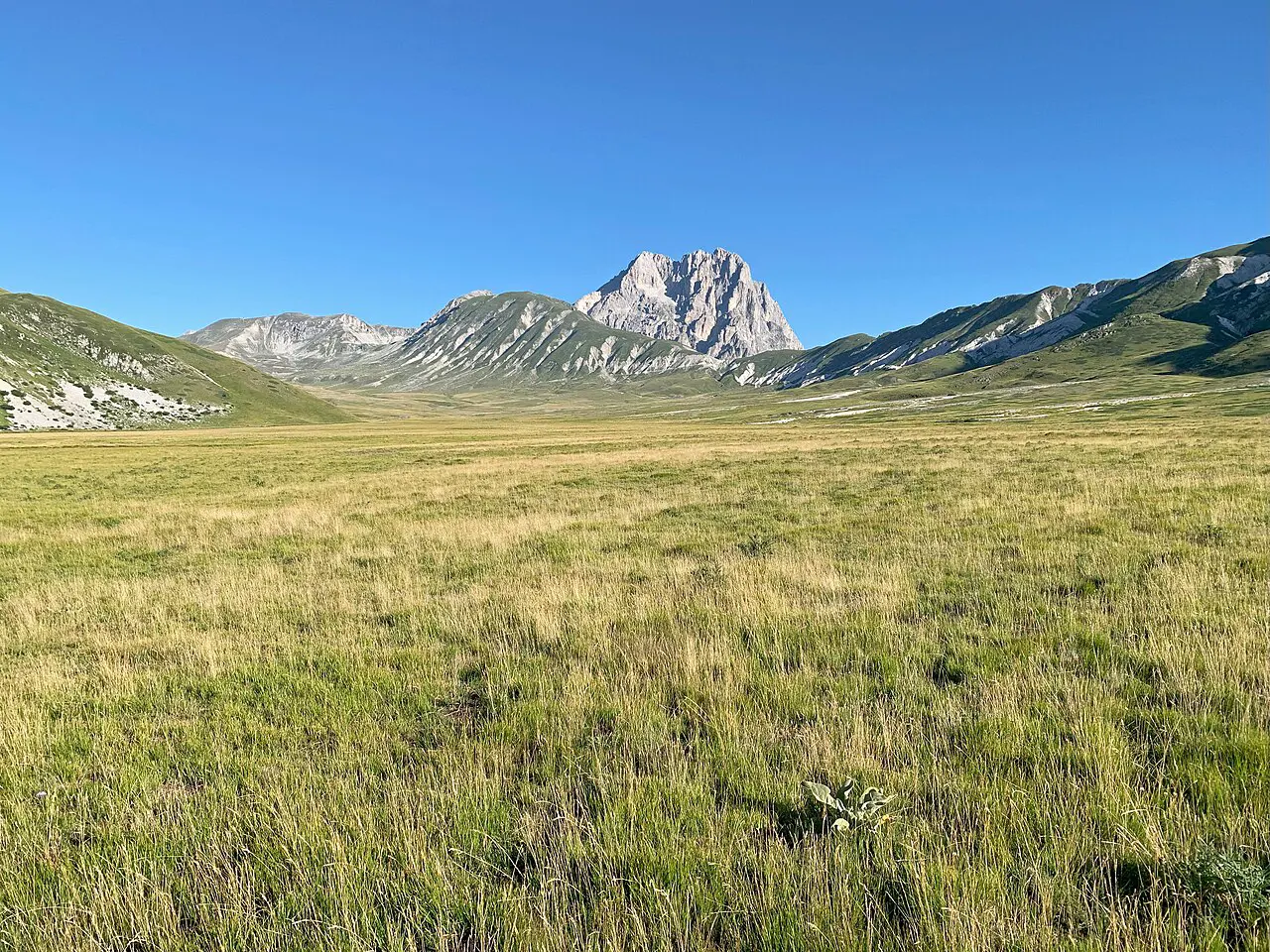
The Gran Sasso does not look like the rest of the Apennines. Seen from the Teramo coast it is a long white wall closing the horizon, and from certain angles it draws the outline of a sleeping woman: hence the name everyone around here uses, the Sleeping Beauty. Close up it is vertical limestone, with faces hundreds of metres high that are ground for real mountaineering, not for a walk.
The mountain
The Corno Grande has three summits. The western one, at 2,912 metres, is the highest and is reached from Campo Imperatore by the normal route: a walk for fit and experienced hikers, with one via ferrata section, not an outing. Below the north face lies the Calderone, the southernmost glacial body in Europe, which has shrunk so far in recent decades that glaciologists have stopped calling it a glacier and speak of a glacieret.
Those who do not climb still have places to go. From the valley station at Fonte Cerreto a cable car reaches Campo Imperatore in about ten minutes, and from there waymarked paths stay high without exposure. The Duca degli Abruzzi hut, at 2,400 metres on the Portella, is a classic half-day objective.
The plateau
Campo Imperatore is the plain at the foot of the massif: twenty kilometres of grassland at eighteen hundred metres, without a single tree, with free-roaming herds. It is the bed of an ancient glacial lake, which is why it is so flat in the middle of mountains so steep. In June the pasture flowers all at once, and that is the best time to come. At the top of the road stand the hotel built in 1943, where Mussolini was held prisoner, and the astronomical observatory, which is here for the altitude and the lack of lights around it.
What lies underneath
Under fourteen hundred metres of rock, at the level of the motorway tunnel, are the Gran Sasso National Laboratories: the largest underground particle physics laboratory in the world. The mountain acts as a shield against cosmic rays, and what they are looking for down there is neutrinos and dark matter. It is not open for casual visits, but the visitor centre at Assergi explains what goes on inside.
The animals
The Apennine chamois, which had been wiped out here, was reintroduced in the 1990s with animals from the Abruzzo National Park and now numbers several hundred. It is often seen at dawn on the high pastures, and it is not especially shy. There are also wolves, golden eagles and, for some years now, the occasional bear passing through from the south.